10 Powerful Amla Benefits for Hair Regrowth and Premature Graying
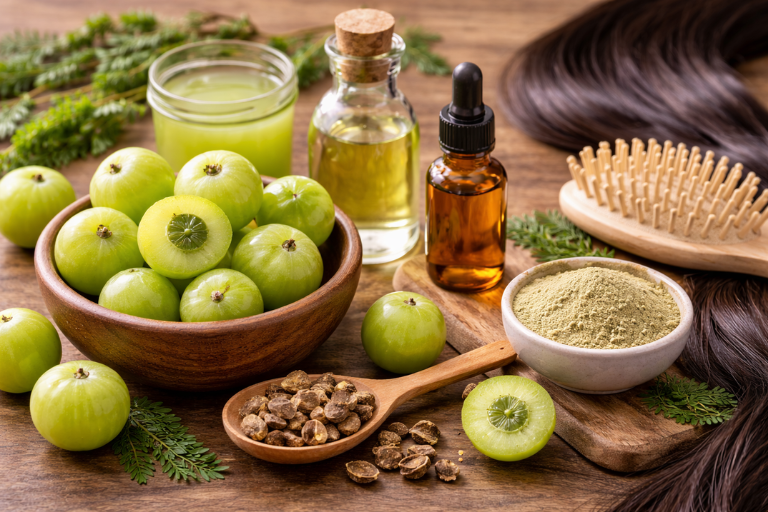
You’re curious about amla because you’ve heard it can boost growth and stall gray hairs. You’re right to ask. This vitamin C–rich fruit may extend the anagen phase, calm scalp inflammation, and support melanin—while strengthening follicles against breakage. But what does clinical evidence actually show, how should you use it (oil, oral, or both), and how does it stack up to minoxidil? Here’s where the science gets interesting.
What the Clinical Evidence Says About Amla for Hair Regrowth
Evidence is starting to back Amla’s hair claims, but it’s early days.
You’ve got one triple-blind randomized controlled trial in women with female androgenetic alopecia (FAGA): 60 participants took either Amla syrup (10 cc, three times daily) or a matched placebo for 12 weeks. Researchers used TrichoScan before and after, and both physicians and patients completed CGI-I and PGI-I satisfaction scales.
You should note strong trial design, balanced baselines, and good completion rates (27 Amla, 25 placebo).
Safety looked acceptable—only one mild constipation case resolved with diet, and no remarkable side effects otherwise.
Safety appeared acceptable: just one mild constipation case, diet-resolved; no other notable side effects.
Traditional Persian Medicine also endorses Amla as a hair tonic.
Preclinical work adds plausibility: Amla oil sped fur growth and improved coat health in animals, and showed antiparasitic effects, though species differences limit generalization.
In that clinical trial, Amla significantly increased the anagen percentage and the anagen-to-telogen ratio compared to placebo.
Key Outcomes in Women With FAGA (Anagen, Telogen, Ratios)
In just 12 weeks, Amla syrup shifted hair-cycle dynamics in women with FAGA toward growth: anagen percentage rose markedly (F=24.7, p<0.001) while telogen percentage fell (F=12.6, p<0.001), improving the anagen-to-telogen ratio (F=10.4, p<0.002).
You’ll see why this matters. Anagen is the active growth stage; more follicles in anagen mean a larger share producing new strands. Telogen is the resting/shedding stage; fewer telogen hairs mean less time spent off-growth. Together, these shifts rebalance your scalp toward density.
The evidence is robust: a triple-blind, randomized controlled trial of 60 women (18–60 years) used 10 cc Amla syrup three times daily. Triple-blind design increased confidence in the findings and minimized bias across participants, clinicians, and assessors.
TrichoScan phototrichogram analysis objectively quantified anagen and telogen changes, with no baseline imbalances between groups. Participants met FAGA criteria (Ludwig I–II, >6 months loss).
These statistically significant gains align with higher patient and physician improvement ratings.
How Amla May Reduce Shedding and Breakage
While shedding and breakage have different roots, amla targets both. You curb shedding by calming follicle inflammation and modulating hormones that miniaturize hair. Daily amla oil cut hair loss 35% in eight weeks, likely from its anti‑inflammatory action and its strong 5‑alpha‑reductase inhibition.
In clinical use, hair fall VAS scores dropped from 6.2 ± 1.7 to 3.4 ± 1.5. Amla also downregulates IL‑6 and upregulates β‑catenin–linked growth genes, helping follicles hold onto strands longer. For breakage, amla’s fatty acids coat the cuticle, sealing moisture, reducing friction, and improving manageability. That protective film limits snap‑offs during styling. Its antimicrobial phyllemblin helps reduce dandruff and dermatitis that can weaken shafts.
Side effects are uncommon; very rarely, irritation or pigment changes occur with UV exposure. Research suggests amla oil can enhance hair growth, supporting its use as a natural option for hair health.
How Amla May Boost Thicker-Looking Hair (Anagen Support)
Beyond taming shed and snap, amla can help your hair look fuller by supporting the anagen—active growth—phase.
During anagen, follicles enlarge, bulbs regenerate, and shafts are produced; about 85–90% of your scalp hairs live here. When you keep more follicles in anagen longer—often 6–8 years—you see denser coverage and thicker-looking strands because follicle size and hair fiber output rise. During the anagen phase, hair follicles actively produce fibers and typically comprise 85–90% of scalp hairs.
Amla in polyherbal oils (with hibiscus and coconut) can nourish the scalp, condition fibers, and keep follicles active.
Better moisture and scalp care support the dermal papilla, which feeds follicles oxygen and nutrients essential for rapid cell multiplication.
Antioxidants in Amla That Protect Follicle Stem Cells
Even as daily stressors bombard your scalp, amla’s dense antioxidant arsenal helps safeguard the follicle’s most essential assets—its stem cells.
You get a rare blend: vitamin C that outpowers many fruits, stabilized by tannins so it stays active through processing. This vitamin C drives collagen production, fortifying the follicle’s structure and reducing breakage tied to deficiency. Additionally, ginger’s antioxidant properties can further enhance scalp health by neutralizing harmful free radicals.
Polyphenols and flavonoids team up to neutralize UV- and pollution-driven free radicals, protect DNA, and preserve melanocytes to resist premature graying. Their broad antioxidant action supports larger follicle size and helps maintain a longer anagen phase—keys for robust regrowth.
Flavonoids also enhance microcirculation, improving nutrient delivery to stem cell niches. Meanwhile, tannins extend antioxidant efficacy and aid nutrient absorption, creating a resilient environment where follicle stem cells can survive and proliferate.
Amla delivers an exceptionally high vitamin C content—about 478 mg per 100 g—supporting immune and skin health while bolstering hair follicle resilience.
Calming Scalp Inflammation to Support Regrowth
Amla doesn’t just shield follicle stem cells; it also calms the inflamed scalp that sabotages regrowth. Its anti-inflammatory action downregulates markers like IL-6, eases itching and burning linked to excess Pitta, and supports fuller growth. Additionally, its rich content of prebiotic fibers can foster a healthy scalp microbiome, further promoting overall hair health.
In trials, amla oil cut hair loss by 35% in eight weeks, while serums with amla slashed itching by day 60 and improved density by 40% in 12 weeks.
You benefit from vitamin C, tannins, emblicanin-A/B, gallic acid, and vitamin E, which protect follicles, enhance circulation, and promote regeneration.
Amla’s antifungal and antibacterial effects reduce dandruff, excess sebum, and dryness, creating a healthier growth environment. Cold-pressed or CO₂-extracted formulas help preserve vital nutrients, ensuring the scalp microbiome stays balanced and supportive of healthy growth.
Apply cold-pressed amla oil daily to target inflammation. It’s dermatologically safe with no reported adverse events; rare irritation may occur after UV exposure.
Can Amla Help Slow Premature Graying?
Curious whether you can slow the march of grey? Amla helps by shielding follicles from free radicals that speed premature graying. Its vitamin C and antioxidants neutralize oxidative stress, protecting follicle structures and supporting natural pigmentation.
Consistent use—dietary or topical—may reduce the rate oxidative damage accumulates. Clinical studies have shown that formulations containing amla can improve hair density and growth in humans and animals.
Amla may also support melanin production, the pigment that gives hair its color. While it won’t reverse existing grey, regular use can encourage new growth with richer tone over time—a preventative, not a cure.
Nutrition matters, too. Amla offers vitamin C, iron, and minerals that back hair strength and address deficiencies linked to early greying. Try about one teaspoon daily.
Set realistic expectations: genetics and age still lead, but steady use can slow the process gradually.
Amla Oil for Scalp Balance (and Parasites)
While a calm, clean scalp sets the stage for thicker growth, the right amla oil can do more than moisturize. It balances your scalp’s microflora with antimicrobial phyllemblin, gallic acid, and ellagic acid, curbing harmful yeast and bacteria that trigger dandruff and seborrheic dermatitis.
Amla oil calms, balances microflora, and curbs dandruff-causing yeast and bacteria for thicker growth
Research shows amla extract counters fungal and bacterial conditions, supporting a healthier follicle environment.
It’s also a quiet parasite buster. An Indian study found amla oil the most toxic to hair parasites among four hair products, and several small studies report it helps keep scalps parasite-free.
Animal work even noted rapid fur return on parasite-prone areas. A 2012 study identified amla fruit as an inhibitor of 5α-reductase, a mechanism also targeted by prescription hair-loss medications.
Anti-inflammatory action seals the deal: reduced IL-6 signaling and calmer Pitta correlate with less shedding.
Choose cold-pressed or CO₂-extracted oils in plant-based carriers—avoid mineral oil blends.
How to Use Amla: Oral, Oil, Combo
Even before you pick a product, decide how you’ll use amla: by mouth, on your scalp, or both for synergy. If you go oral, syrups and tablets are the main options. Amla products are widely available in health stores and online.
In women with FAGA, 12 weeks of amla syrup improved anagen percentage, lowered telogen percentage, and raised the anagen:telogen ratio versus placebo, with higher satisfaction; one constipation case resolved with diet. Vedistry Amla+ tablets also improved growth and texture in a clinical trial.
If you prefer topical, apply amla oil directly to the scalp. Small studies and animal data show faster growth, less shedding, stronger strands, and antiparasitic activity.
For a combo approach, take an oral form while massaging oil into the scalp. Tradition and preclinical data support complementary benefits.
Safe Dosing, Timelines, and What Results to Expect (Plus How It Compares to Minoxidil)
So how much amla should you use—and how soon will you see changes? Use amla oil 3–4 times weekly, or apply hair masks/powder packs 2–3 times weekly (twice weekly is fine). Drink a small daily dose of amla juice. This routine balances topical and oral support. A key reason for these benefits is amla’s high vitamin C content, which supports collagen production and strengthens hair follicles. Additionally, amla’s nutrient transporter properties enhance the absorption of key vitamins that promote hair health.
What to expect: by day 7, hair often feels stronger with fewer breakages. At 2 weeks, many notice thicker roots, more volume, and calmer dandruff or itch. Length gains of about an inch have been observed within two weeks.
From 8–16 weeks, density and diameter typically rise; continued use beyond 16 weeks deepens benefits.
For premature graying, commit to 3–6 months or longer; steady daily intake helps melanin retention.
Compared to minoxidil: a 5% DA-5512 (amla-containing) formula outperformed 3% MXD in density, diameter, and growth rate at 16 weeks, likely via antioxidant pathways, though direct trials remain limited.
Frequently Asked Questions
Can Amla Interact With Common Supplements or Prescription Hair-Loss Medications?
Yes. You can combine amla with most supplements, but monitor interactions. It may increase bleeding with aspirin or clopidogrel and lower blood sugar with diabetes drugs. Check cumulative dosing, avoid multiple new supplements at once, and consult your provider.
Is Amla Safe During Pregnancy or Breastfeeding for Hair Support?
Yes—small, food-level amounts of amla are generally safe in pregnancy and likely okay while breastfeeding. Avoid high-dose supplements. Start low, watch for GI upset or allergies, avoid with blood thinners, and consult your provider, especially with gestational diabetes.
Does Amla Affect Iron Absorption or Anemia Risk?
Yes. You can boost non-heme iron absorption with amla’s vitamin C at modest amounts, improving anemia markers. But high amla or tannin-rich forms can inhibit absorption in rice, sorghum, and pulses. Pair wisely; monitor labs.
Are There Allergens in Amla Oil Carriers (E.G., Sesame, Coconut)?
Yes. You could react to carriers: sesame (common allergen), coconut (rare but documented), and peanut (avoid with legume allergies, cross-contamination risks). Patch test first, read labels, choose cold-pressed, fragrance-free formulas, and consult professionals, especially for pregnancy or children.
How Should Sensitive Scalps Patch-Test Amla Oil to Avoid Irritation?
Do a 24–48 hour patch test behind your ear with diluted amla oil. Apply a pea-sized amount, don’t wash. Monitor redness, rash, itching, burning. Document results. If any reaction appears, stop immediately and consult a professional.
Conclusion
You’ve got a proven, multitasking ally in amla. It supports the anagen phase for thicker-looking hair, reduces shedding and breakage, protects follicle stem cells with antioxidants, and may slow premature graying by supporting melanin. Use it orally, as an oil, or both to nourish your scalp and calm inflammation. Dose safely, stay consistent, and expect gradual gains over months. It won’t replace minoxidil for everyone, but it can complement it—and help you build stronger, denser, more resilient hair.