Sulforaphane Secrets: 7 Cancer-Fighting Benefits of Steamed Broccoli
You’ve heard broccoli’s good for you, but steamed broccoli hides a sharper edge: sulforaphane. It boosts your antioxidant defenses, supports detox enzymes, and helps shield DNA while slowing rogue cell growth. You can even influence how much you get with simple cooking tweaks. Curious about real-world doses, safety, and where the strongest human evidence lies—from prostate to bladder cancer? There are seven targeted benefits you shouldn’t miss—and one mistake that can wipe them out.
What Is Sulforaphane: and Why Broccoli Matters
Powerful yet simple, sulforaphane is a naturally occurring isothiocyanate formed when the enzyme myrosinase acts on glucoraphanin in cruciferous vegetables—especially broccoli.
Sulforaphane forms when myrosinase meets glucoraphanin in cruciferous vegetables—especially broccoli
You trigger this reaction when you chew, chop, or crush the plant, letting myrosinase meet glucoraphanin stored in tissues. The result, sulforaphane, appears as a faintly yellow liquid (C6H11NOS2; 177.29 g/mol) with a predicted 368.2°C boiling point and 1.17 g/cm³ density.
It’s soluble in water, methanol, and DMSO, and it degrades with high oxygen, heat, or basic conditions. Activation of Nrf2 is a primary mechanism by which sulforaphane exerts antioxidant and anti-inflammatory effects that underpin many of its health benefits.
Sulfur’s stereogenic center yields natural R-SFN and synthetic R,S-SFN. After you consume it, sulforaphane rapidly enters cells and follows the mercapturic acid pathway: it conjugates with glutathione, then enzymes process it to SFN-N-acetylcysteine, excreted in urine.
Broccoli—especially sprouts—delivers the richest precursor.
How to Maximize Sulforaphane When Steaming Broccoli
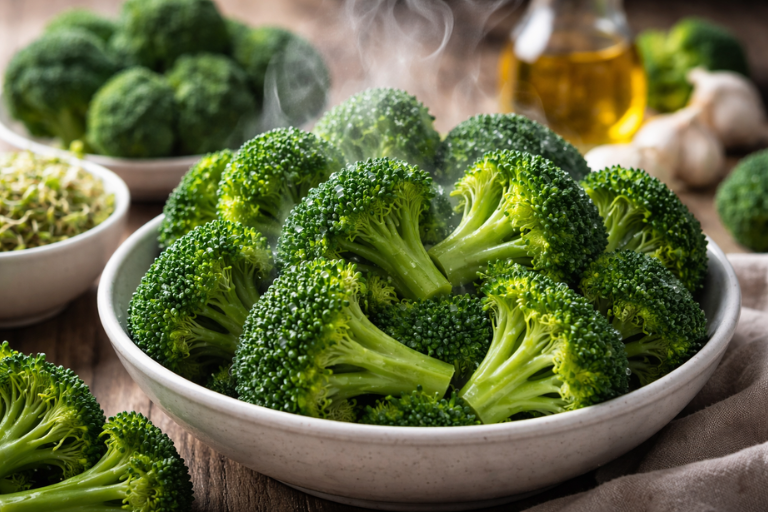
Although broccoli’s nutrients can fade with too much heat, you can steer steaming to release more sulforaphane. Start by chopping broccoli and letting it rest 30–90 minutes—an hour is ideal. This pause lets myrosinase convert glucoraphanin before heat hits.
Set a steamer basket over 1 inch of boiling water, then lower to medium-low and cover tightly. Arrange stems down, florets up. Steam 3–4 minutes until bright green; never exceed 5 minutes to protect myrosinase. For texture, go 5 minutes for small florets, 6 for larger, but keep under 7. For extra nutritional coverage, remember that broccoli also delivers fiber, vitamin C, and vitamin K, so you’ll benefit even if sulforaphane varies.
Want insurance? Briefly steam 2–3 minutes, then pan-sear quickly and toss with a handful of raw chopped broccoli to reintroduce myrosinase. Alternatively, microwave 2–3 minutes and mix with raw.
Keep temperatures gentle—ideally near 60°C.
Sulforaphane in Humans: Benefits, Doses, and Safety
Even beyond the kitchen, sulforaphane shows measurable effects in humans—from dialing down inflammation to improving metabolic and cancer-related markers.
Beyond the kitchen, sulforaphane measurably tempers inflammation and improves metabolic and cancer-related markers in humans.
You can lower IL-6, TNF-alpha, and CRP, dampen NF-κB and inflammasome activity, and ease virus-induced inflammation (even viral load in smokers). It blunts post-meal inflammation and improves platelet function in crossover trials.
For cancer, daily 60 mg active sulforaphane slowed prostate-specific antigen doubling by 86% in men. Regular cruciferous intake (about 4.5 servings/month) links to a 55% lower lung cancer risk, with encouraging signals for bladder, breast, and colon cancers. It also activates phase 2 detoxification enzymes that help deactivate carcinogens and support their excretion.
In type 2 diabetes, you may see ~6.5% fasting glucose reductions, better A1c, and improved insulin sensitivity.
Typical trial doses: 100–150 µmol/day; autism studies used 50–150 µmol for 18 weeks. Generally safe, but consult your clinician about interactions, pregnancy, or pediatric use.
Mechanisms: DNA Protection, Detox, and Antioxidant Defense
While you’re chewing broccoli, sulforaphane (SFN) quietly flips cellular switches that shield your genome and detoxify threats. You blunt carcinogen activation by inhibiting phase I enzymes and boost phase II enzymes that neutralize toxins. In liver-derived HepG2 cells, SFN cuts DNA adducts by 66% within hours, signaling real DNA protection. Additionally, consuming high fiber foods like papaya can enhance overall gut health, complementing the protective effects of sulforaphane.
You also spark Nrf2, the master regulator of cytoprotective genes. SFN reactivates Nrf2 via CpG demethylation and histone acetylation, then drives antioxidant and detox enzymes that drop ROS, mutation burden, and inflammation. Notably, SFN induces apoptosis in cancer cells by increasing Bax and reducing Bcl-x, contributing to its anticancer activity.
SFN reshapes epigenetics: it lowers DNMT1/3a/3b, decreases global methylation, and demethylates promoters like cyclin D2, restoring orderly division.
Apoptosis and Cell-Cycle Arrest: How Sulforaphane Slows Tumors
Because sulforaphane (SFN) hits the brakes on the cell cycle and primes death pathways, tumor cells lose their proliferative edge. You see SFN stall division at two checkpoints.
In G2/M, it elevates cyclin B1 and targets the Cdc2–cyclin B1 complex, piling cells at mitosis; roscovitine blocks this buildup and cuts HT29 apoptosis from 22.2% to 6.55%. A functional proteasome is required for SFN’s apoptotic effect, as proteasome inhibition with MG132 reduces SFN-induced HT29 cell death.
At G1, SFN lowers RB phosphorylation, preserves RB–E2F-1, and drops free E2F-1, curbing ovarian cancer cell growth.
You also push cells toward apoptosis. SFN induces p21 across colon, osteosarcoma, and other lines—often p53-independently—reinforcing arrest.
Then caspases engage: procaspase-9 and PARP cleave, Bak rises relative to Bcl-2, and sub-G1 DNA appears.
In ALL, 7.5 μM couples G2/M arrest with AKT suppression and caspase-driven death; in LM8, 20 μM halts growth completely.
Epigenetics: HDAC Inhibition and microRNA Effects
If you zoom into sulforaphane’s epigenetic reach, you’ll see it rewires gene control at multiple levels to tilt cancer cells toward suppression and death.
You inhibit histone deacetylases, triggering histone hyperacetylation and chromatin opening, which reactivates silenced tumor suppressors. In breast cancer lines (MCF-7, MDA-MB-231), you curb HDAC activity and selectively reduce proliferation, while sparing normal cells. Regular intake of cruciferous vegetables is linked to broad health benefits, with sulforaphane’s anticancer activities highlighted as a key contributor.
You also acetylate non-histone targets like p53, amplifying pro-apoptotic pathways, and you synergize with TRAIL to hit therapy-resistant cells.
At DNA methylation checkpoints, you inhibit DNMTs (DNMT1, DNMT3a, DNMT3b), demethylate CpG islands, and restore tumor suppressor promoters.
At DNA methylation checkpoints, you block DNMTs, demethylate CpG islands, and resurrect silenced tumor suppressor promoters.
You boost Nrf2 by promoter demethylation, reinforcing cellular defenses. Through microRNA modulation, you downshift oncogenic signals and indirectly activate tumor suppressors, coordinating with global demethylation to normalize transcription programs.
Where It Helps Most: Prostate, Breast, Colon, Bladder, and Oral Cancer Evidence
Beyond its epigenetic prowess, sulforaphane shows the clearest promise in prostate, breast, colon, bladder, and oral cancers, where preclinical and early translational data converge on prevention and therapy.
In prostate models, you see Nrf2/ARE activation, mitochondria-driven apoptosis, and STAT3 inhibition that lowers bcl-2, cyclin D1, and survivin; TRAMP mice fed broccoli sprouts had slower tumor growth, supporting human potential, especially in high‑risk disease. Large phase 3 trials are still needed to confirm chemopreventive efficacy in high‑risk populations.
For breast cancer, you target DNA mutation blocking, stem-like cell suppression in triple‑negative models via Cripto pathway control, and stronger prevention when exposure begins prenatally; vesicle-encapsulated SFN boosts uptake.
In colon cancer, you induce phase‑2 enzymes (NQO1, HO‑1, γ‑GCS), block procarcinogen activation, and benefit from controlled-release extracts.
Bladder studies show HDAC inhibition, G2/M arrest, and apoptosis. Oral cancer signals trend protective, too.
Frequently Asked Questions
Does Frozen Broccoli Contain Enough Myrosinase to Produce Sulforaphane?
No. Most frozen broccoli’s been blanched hot, inactivating myrosinase, so you won’t form much sulforaphane. Use lower-blanched products, add a myrosinase source like raw daikon or mustard powder, or choose sprouts frozen at −20°C and blend immediately.
How Do Genetics (Gstm1/Gstt1) Affect Sulforaphane Benefits?
They shape both metabolism and protection. If you’re GSTM1-positive, you often gain greater cancer-risk reduction despite faster clearance. If you’re GSTM1- or GSTT1-null, you metabolize sulforaphane slower, show higher metabolite exposure and excretion, yet sometimes yield less net protection.
Can Gut Microbiome Differences Change Sulforaphane Activation and Absorption?
Yes. Your gut microbiome shapes sulforaphane activation and absorption by converting glucoraphanin via microbial “myrosinase.” Microbial balance shifts isothiocyanate vs nitrile production; Bifidobacterium, Dorea, and Ruminococcus torques boost excretion, while Alistipes and Blautia reduce it. Diet modulates this.
Do Broccoli Sprouts Outperform Mature Broccoli for Sulforaphane Yield?
Yes. You’ll get dramatically more sulforaphane from raw broccoli sprouts than mature broccoli—often 10–100× higher, with better absorption. Eat 60–150 g sprouts daily for 30–60 mg sulforaphane. Keep them raw to preserve myrosinase and maximize conversion.
Are There Drug or Supplement Interactions With Sulforaphane-Rich Foods?
Yes. You should watch for interactions via CYP1A2, CYP2E1, and CYP3A4. Sulforaphane can alter furosemide, verapamil, ketoprofen, local anesthetics, and chemo effects. Don’t mix rashly; consult your clinician, especially with blood thinners, anticonvulsants, or seizures.
Conclusion
You’ve got a simple, powerful ally in steamed broccoli. By maximizing sulforaphane—chopping, waiting, then lightly steaming—you’ll boost your antioxidant defenses, protect DNA, and support detox pathways. The evidence points to real-world benefits in prostate, breast, colon, bladder, and oral cancers, with promising human safety and dosing guidance. Sulforaphane even nudges cancer cells toward apoptosis and cell-cycle arrest while reshaping epigenetics. Make it a regular habit, and you’ll stack the odds in your favor with every vibrant green bite.