7 Muscle-Building Benefits of Creatine Monohydrate for Beginners
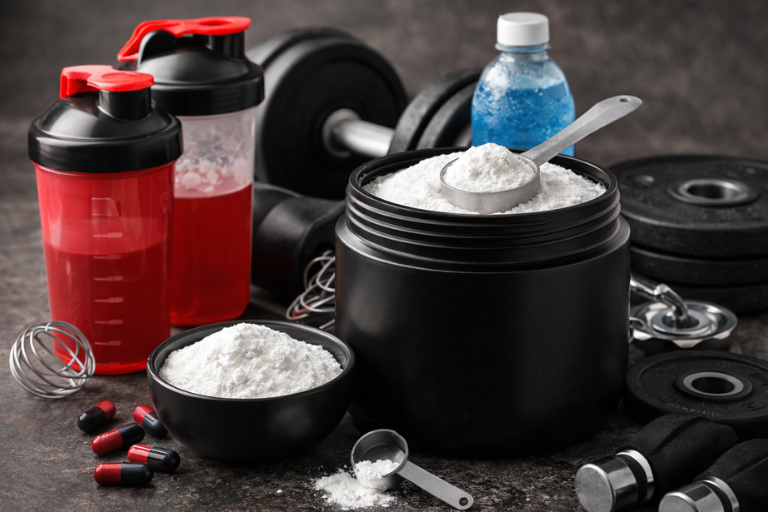
If you’re new to lifting, creatine monohydrate can quietly stack the odds in your favor. It helps you push a few extra reps, recover faster between sets, and build lean mass more efficiently, without turning your routine upside down. You’ll also notice changes in muscle fullness, strength in the first weeks, and even how fatigued you feel. The real advantage, though, comes when you understand how each of these benefits actually works for you.
How Creatine Monohydrate Works for Beginners
When you start taking creatine monohydrate, it mainly works by boosting your muscles’ immediate energy supply so you can push harder during short, intense efforts. Your muscles store more phosphocreatine, which rapidly regenerates ATP, the fuel for heavy lifts and explosive movements. This lets you perform more quality reps and sustain high-intensity sets.
Creatine also pulls water into your muscle cells, creating cell volumization. That extra intracellular fluid acts as an anabolic signal, turning on protein synthesis pathways and helping reduce protein breakdown. Because it’s one of the most extensively researched sports supplements, creatine monohydrate has a strong record of safety and effectiveness for healthy beginners.
At the cellular level, creatine influences mTOR, satellite cell activity, IGF-1, and myostatin, all of which tilt the balance toward muscle building over muscle loss. Together, these changes improve your capacity to train hard and support muscle growth.
Beginner Strength Gains in Your First 4–12 Weeks
As creatine ramps up your muscles’ immediate energy system, those cellular changes start to show up in the numbers you can actually lift.
In your first 4–12 weeks, you can expect strength to climb faster than with training alone, especially if you’re new to lifting. These adaptations are supported by decades of research showing creatine as one of the most well‑supported ergogenic aids for high‑intensity performance.
Within 1–2 weeks, studies show beginners already improving bench, leg press, and shoulder press strength, along with short, all-out cycling sprints.
Over 4 weeks, creatine often delivers around a 5% boost in strength and power, with some trials reporting ~18 pounds added to bench press 1RM.
Across 8–10 weeks of structured training, adding creatine consistently improves heavy lifts like the squat, bench press, and power clean, and increases high‑intensity anaerobic capacity by roughly 5–15%.
How Much Lean Muscle You Can Gain on Creatine
Most people who lift consistently and use creatine gain a modest but meaningful amount of extra lean mass—typically around 1–1.5 kg (2–3 lb) more than training alone over a few months.
Most consistent lifters gain roughly 1–1.5 kg of extra lean mass from creatine over a few months
Meta-analyses show about 1.1–1.4 kg greater lean mass gains with creatine, even when researchers exclude lower‑quality studies.
You’ll likely notice faster changes in the first week, sometimes around 0.5 kg, mostly from extra water pulled into your muscles.
That temporary bump varies a lot and isn’t pure new muscle tissue. Creatine is also considered one of the safest and most well‑researched performance supplements available for beginners.
Over 4–12 weeks, though, you can realistically expect about 1 kg or more additional lean mass if you train hard and take creatine consistently.
Some studies show smaller or no extra gains, but overall evidence still favors a modest advantage.
How Creatine Improves Your Workout Performance
Creatine boosts your workout performance by supercharging how your muscles produce energy during intense efforts.
By increasing phosphocreatine stores in your muscles, creatine helps you rapidly regenerate ATP, the fuel you use for heavy lifts, sprints, and explosive movements.
With higher creatine levels—often 20–40% above baseline—you can push harder and maintain top-end effort longer. Creatine monohydrate is also the most studied and well-supported form of creatine, with strong evidence for both its safety and effectiveness when taken at recommended doses.
Here’s how that shows up in your training:
- You lift heavier weights and hit more reps on key lifts like squats and bench press.
- You improve short sprints, explosive jumps, and quick changes of direction.
- You increase training volume, doing more total work in each session.
- You stimulate more muscle growth by consistently training at higher intensities.
Creatine for Endurance and Faster Recovery
While many people associate it with short, explosive efforts, creatine also supports endurance and speeds up recovery between hard sessions. By boosting phosphocreatine stores, you regenerate ATP faster, so you can push harder during intervals, surges, and end‑spurt efforts in sports like rowing, cycling, and triathlon.
Research shows creatine can enhance power in repeated high‑intensity bouts and extend time to exhaustion, especially in efforts up to about three minutes. It may also improve VO2 kinetics, helping your muscles use oxygen more efficiently during demanding endurance efforts.
Creatine also helps you bounce back. It buffers hydrogen ions to reduce muscle acidosis, supports calcium handling for stronger contractions, and lowers inflammation and oxidative stress after tough workouts.
When you combine creatine with carbs or protein, you also refill glycogen more effectively, improving recovery before your next demanding endurance or interval session.
Fuller Muscles: Water Weight or Real Gains?
As you start to notice better endurance and faster recovery on creatine, you’ll probably also see your muscles look fuller on the scale and in the mirror—and that raises a common question: is it just water, or real size?
In the first week, most of that “pop” comes from water. Creatine pulls more water into your muscle cells as phosphocreatine levels rise, so they swell slightly and look rounder, even before you’ve trained much. Research also shows that with proper training, creatine can support real muscle hypertrophy rather than just temporary water retention. Moreover, consistent training can enhance metabolic functions that contribute to muscle growth.
But that’s not the whole story.
Over weeks of consistent lifting, studies show real lean mass gains and greater muscle density. To understand what’s happening, focus on:
- Where the extra water goes
- How quickly creatine stores increase
- Changes in scale weight vs strength
- Lean mass gains over 4–12 weeks
How Creatine Affects Hormones, Muscle Breakdown, and Injury Risk
Even though most people think about creatine strictly as a performance booster, it also quietly influences the internal environment that controls how much muscle you build and how well you stay injury-free.
Creatine can raise IGF-1 and other anabolic hormones, and it supports satellite-cell signaling that drives repair. Some trials don’t measure hormones directly, so researchers sometimes infer these effects from training-volume and growth changes. Recent findings suggest that at typical doses, creatine may have little impact on additional muscle gain beyond well-designed training alone.
Creatine also helps you keep more of the muscle you build. It tends to reduce protein breakdown, lower myostatin (a growth “brake”), and decrease post-workout CK, a marker of muscle damage.
Studies show less damage and faster recovery within 24–96 hours.
Injury risk doesn’t appear to increase; cramps may drop and strength gains can reduce falls, especially in older adults.
Frequently Asked Questions
Is Creatine Monohydrate Safe for Complete Beginners and Long-Term Daily Use?
Yes, you can safely use creatine monohydrate as a complete beginner and for long-term daily use when you stick to recommended doses, stay hydrated, choose third‑party tested products, and monitor kidney function if you’re at risk.
Do I Need a Loading Phase or Can I Start With a Low Dose?
You don’t need a loading phase; you can start with 3–5g daily. You’ll reach the same muscle saturation, just slower. Pick loading only if you want faster results and tolerate possible bloating or stomach discomfort.
What Time of Day Is Best to Take Creatine for Muscle Gains?
You’ll build muscle best by taking creatine either right before or right after training, whenever you’ll remember it. Aim for 3–5 grams daily; consistency matters far more than exact timing for long-term gains.
Should Beginners Cycle off Creatine or Take It Continuously Year-Round?
You should take creatine continuously year-round, not cycle it. You’ll keep muscles saturated, support steady strength and size gains, and avoid performance dips. Stick with 3–5 grams daily, assuming you’re healthy and your doctor’s comfortable with it.
Can Teenagers or Older Adults Safely Use Creatine to Build Muscle?
Yes, both can, but under different conditions. As a teen, you should only use creatine with medical and parental supervision, correct dosing, and hydration. As an older adult, you’ll generally use 3–5g daily safely.
Conclusion
Creatine monohydrate gives you a simple, proven way to build muscle faster as a beginner. You’ll push harder in your workouts, recover quicker, and see strength and size gains within weeks. The extra water in your muscles supports real growth, not just “bloat,” while reduced breakdown and better hormone support keep progress steady. Use creatine consistently, pair it with smart training and nutrition, and you’ll turn beginner gains into a solid foundation of long-term muscle.