15 Body Skin Care Routine Tips for Smooth, Healthy Skin All Year
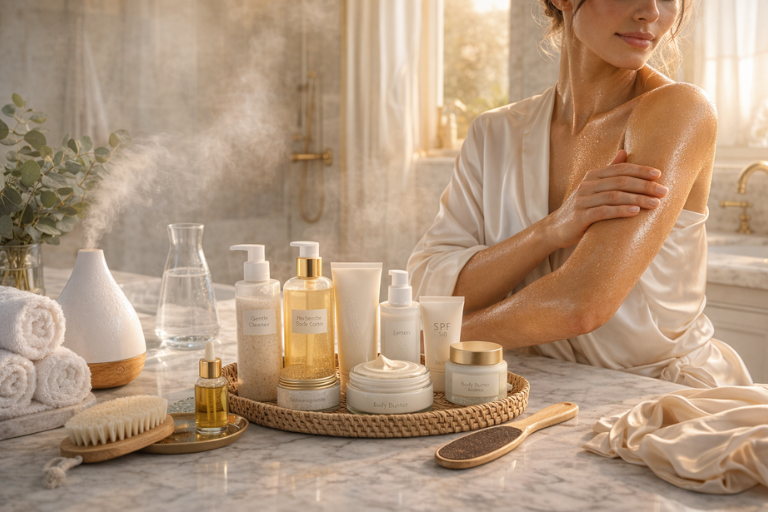
You want smooth, healthy skin year-round, but the routine that gets you there is simpler—and smarter—than you think. Start with a few daily habits that protect your barrier, then layer in targeted treatments for texture, breakouts, and sun damage. From lukewarm showers to pH-balanced cleansers, timing matters as much as products. You’ll also need to tweak your moisturizer with the seasons and use sunscreen properly. Here’s where most routines go wrong—and how to fix yours.
Your Daily Body Skincare Routine (Quick Start)
Even on busy days, a simple body routine keeps your skin clean, comfortable, and resilient.
In the shower, use a gentle, pH‑balanced body wash to lift sweat, oil, dirt, and pollutants without stripping lipids. Choose hydrating or cream formulas if your skin runs dry or sensitive, and keep water lukewarm to reduce post‑shower tightness. Daily moisturizing helps maintain the skin barrier, protecting against pollution and harsh weather, as a strong skin barrier reduces susceptibility to dryness and irritation.
Focus cleansing on scalp, folds, and feet; avoid over‑washing less soiled areas. If you’re reactive or eczema‑prone, stick to fragrance‑free or low‑fragrance options.
After toweling, within 3–5 minutes, smooth on a body moisturizer. Favor creams or lotions with occlusives, humectants, and emollients—think ceramides, hyaluronic acid, glycerin, or plant oils.
Use richer body formulas on knees, elbows, and heels. Consistent daily moisturizing improves softness, elasticity, and overall barrier function.
Set Your Body Skin Goals and Type
Now that you’ve got a simple daily routine, set clear body skin goals by figuring out your baseline type and sensitivities.
Identify your type: dry (tight, rough, dull, flaking), oily (shiny, thicker, enlarged pores on back/chest/shoulders), combination (oilier trunk, drier limbs), normal (balanced), or sensitive (stinging, burning, itching, redness). Choosing products that fit your type helps your routine work better by avoiding mismatch and irritation, so opt for skin‑type appropriate formulas. Collagen supplementation can play a crucial role in enhanced skin hydration and overall skin vitality, which can further improve your skin type’s condition.
Remember, genetics set the baseline, but age, hormones, stress, climate, and humidity shift it.
Genetics set your baseline—but age, hormones, stress, climate, and humidity constantly shift your skin’s needs.
Gauge sensitivity separately—it can overlay any type and often reflects a weakened barrier.
Note your Fitzpatrick type and sun response: I–II burn easily; III–IV tan more; V–VI rarely burn but hyperpigment after irritation.
Translate findings into targets:
- dry skin—restore lipids and hydration, reduce water loss;
- oily or acne‑prone trunk—regulate sebum and limit clogging;
- combination—treat regions differently;
- sensitive—minimize irritants, strengthen barrier.
Take Lukewarm Showers, Not Hot
Although steamy showers feel soothing, switch to lukewarm water to protect your skin’s barrier and natural oils. Hot water dissolves sebum, disrupting the lipid film and microbiome, which invites dryness, tightness, flaking, and sensitivity.
Lukewarm cleansing maintains stable barrier function, shielding you from irritants, environmental stressors, and microbial imbalance, while avoiding pH disruption and inflammation. Additionally, using home remedies such as olive oil can help further enhance skin hydration and promote overall skin health.
Keep water around 98–100°F (37–38°C)—warm, not steaming or reddening on contact. Limit time to reduce transepidermal water loss and post‑shower dehydration. Hot water can also trigger inflammation, leading to redness, itching, and peeling similar to a mild burn.
Lukewarm temperatures also minimize redness, burning, itching, and mast‑cell–triggered histamine release, especially if you’re sensitive, eczema‑prone, or dealing with psoriasis or rosacea.
You’ll still support comfortable circulation without thermal stress or blood‑pressure swings. Finish with a brief, slightly cooler rinse to refresh and preserve hydration.
Choose a Gentle, pH-Balanced Body Wash
Because your skin’s surface is naturally slightly acidic (about pH 4.5–5.5), choose a gentle, pH‑balanced body wash that matches that range.
Opt for a gentle, pH‑balanced body wash (pH 4.5–5.5) to protect skin’s acid mantle.
Many conventional soaps sit around pH 9–10, which disrupts the acid mantle, strips lipids and natural moisturizing factors, and leaves you dry, flaky, and irritated. Using a pH‑balanced body wash helps maintain the skin’s acid mantle, which protects against bacteria and irritation.
Pick formulas labeled “pH‑balanced” or “pH 5–6.” Favor mild surfactants and coconut‑based cleansers over harsh sulfates.
Look for humectants like glycerin to counter cleansing‑induced dryness, plus soothing additives such as aloe or vitamin complexes. Low‑level acids (e.g., lactic or glycolic) can help maintain pH and provide light, non‑stripping exfoliation.
Keeping cleansing in the skin’s range supports barrier integrity, reduces transepidermal water loss, boosts hydration, and calms sensitivity.
It also supports a healthy microbiome, helping curb irritation, odor, and breakout risk.
Pat Skin Dry to Reduce Friction
Pat your skin dry instead of rubbing to cut friction, protect your barrier, and keep moisture where it belongs. Rubbing drags delicate tissue, sparks irritation, and can trigger redness, especially if your skin is sensitive, acne‑prone, or mature.
Gentle patting avoids unnecessary stretching, helps preserve collagen, and minimizes premature lines and sagging. This method is ideal for sensitive skin because it reduces irritation and supports a healthier skin barrier.
Use a clean, soft towel and light, repetitive taps—no wiping or tugging. This keeps natural oils intact, supports a resilient barrier, and removes excess water without dehydrating your skin. Patting leaves skin slightly damp, so apply moisturizer within 60 seconds to lock in hydration.
Pay extra attention to friction‑prone spots: under breasts, groin, and skin folds. Pat thoroughly to reduce trapped moisture, calm inflammation risk, and keep these areas comfortable.
Exfoliate 1–3 Times a Week (Not Daily)
Smart exfoliation is a rhythm, not a race: aim for 1–3 times a week to smooth texture, clear pores, and boost glow without stripping your barrier. Regular exfoliation can enhance cellular renewal by up to 30%, supporting a smoother, more youthful appearance.
Start at once weekly for face and body, then increase only if your skin stays calm—no sting, redness, or tightness. Normal skin usually thrives at 2–3 times weekly. Oily and acne‑prone skin may handle more frequent sessions, especially in warmer months, but you still shouldn’t exfoliate your body daily.
Dry or sensitive skin should stick to once, maybe twice weekly, and pause at the first sign of irritation.
- Feel in control: adjust slowly as your skin acclimates.
- Feel confident: consistent care can cut breakouts dramatically.
- Feel protected: stop if redness appears.
- Feel seen: your skin’s response sets the frequency.
Choose Physical vs Chemical Body Exfoliants
Wondering whether to scrub or to swipe on acids?
Physical exfoliants use friction—think sugar or salt scrubs, loofahs, brushes, mitts, or fine rice/jojoba powders—to manually lift dead cells at the surface.
Chemical exfoliants use acids or enzymes—AHAs, BHAs, PHAs, fruit enzymes—to dissolve the bonds between cells so they shed more evenly.
Physical results depend on pressure, strokes, and particle size; chemicals act more uniformly and can offer tone, texture, and barrier benefits. Chemical exfoliation can cause redness, dryness, and sun sensitivity, so follow with moisturizer and daily sunscreen.
Match method to your skin: choose AHAs (glycolic, lactic) for dry, dull, or sun-damaged skin; BHAs (salicylic) for oily or acne-prone back, chest, or butt; low-strength AHAs, PHAs, or enzymes for sensitive skin; AHAs for keratosis pilaris; gentle physical tools for thicker spots like elbows, knees, and heels—follow with emollients.
Apply sunscreen after chemical exfoliation.
Spot Signs of Over-Exfoliation to Avoid Damage
Even when exfoliation feels productive, your skin will warn you when it’s had too much. Watch for persistent redness that lingers into the next day, burning or stinging with water, and a tight, dehydrated feel that moisturizer can’t fix. Flaky patches, a waxy-yet-dry “glassy” look, and roughness that won’t smooth with more scrubbing all signal barrier damage. Over-exfoliation can disrupt the barrier, making skin more vulnerable to irritation and environmental stressors.
- You feel defeated: breakouts spike, tiny rash-like bumps appear, and oiliness paradoxically increases.
- You feel fragile: skin turns papery-thin, patchy-dry yet congested, and stings from once-gentle products.
- You feel exposed: wind, cold, or towels trigger redness; pre-existing acne or rosacea looks angrier.
- You feel set back: dark spots deepen, tone turns blotchy, fine lines creep in, and healing slows.
If you’re layering multiple acids, retinoids, or scrubs often, that’s a red flag.
Moisturize on Damp Skin for Lasting Hydration
Right after you step out of the shower, pat your skin until it’s damp—not dripping—and seal in that water with moisturizer. This timing matters: skin loses moisture quickly in the post‑bath “flash‑drying” phase. Applying right away traps surface water in the stratum corneum, boosting hydration and plumpness while improving barrier function. Applying products on damp skin enhances absorption, helping active ingredients work more effectively.
Use enough product to create a thin, even film. Occlusive formulas curb transepidermal water loss, preventing evaporation and converting leftover droplets into retained moisture; petrolatum can reduce water loss by up to ~99%.
Humectants like glycerin and urea pull water from the damp surface into the outer layers, supporting smooth texture and normal shedding.
Make it a habit daily, and consider a second application the next morning for stronger, longer‑lasting hydration.
Use Barrier Ingredients: Ceramides, Glycerin, HA
Because your barrier does the heavy lifting to keep water in, prioritize moisturizers that pair ceramides with humectants like glycerin and hyaluronic acid.
Ceramides rebuild the lipid lamellae that make up about half of your stratum corneum’s barrier, cutting TEWL and easing dryness, irritation, and sensitivity. The skin’s acid mantle helps defend against pathogens by maintaining a slightly acidic pH 5.4–5.9.
Glycerin draws water into the outer layer and stabilizes the barrier when blended with lipids, delivering smoother texture. Multi-weight HA hydrates both surface and deeper epidermal layers; lipids then lock that water in for durable comfort.
- 1) Feel relief as tight, flaky skin softens fast.
- 2) Gain confidence with smoother, calmer-looking arms and legs.
- 3) Enjoy lasting hydration that doesn’t fade by midday.
- 4) Rest easy knowing your barrier gets stronger over time.
Look for biomimetic formulas with ceramides, cholesterol, and fatty acids; antioxidants help protect these lipids.
Target Rough Zones: Elbows, Knees, Hands, Feet
Although they work hard every day, your elbows, knees, hands, and feet need targeted care to stay smooth and comfortable.
Focus exfoliation and hydration where friction builds. Use a gentle mechanical scrub or a loofah 1–2 times weekly to lift hyperkeratotic buildup, then stop—over‑exfoliation spikes irritation and water loss.
Target rough zones: exfoliate gently 1–2 times weekly, then pause—overdoing it triggers irritation and moisture loss.
Layer in chemical softeners on rough elbows, knees, and feet: lactic acid, ammonium lactate, urea, or glycolic acid to smooth calluses, brighten dark patches, and boost flexibility.
After bathing, treat slightly damp skin with emollient lotions or richer balms—shea butter, antioxidant oils, or barrier balms with squalane—to lock in moisture.
Condition with plant oils to add slip and seal hydration. Reapply hand cream throughout the day, especially after washing.
Use warm water and gentle, fragrance‑free cleansers.
Switch Moisturizer Textures With the Seasons
As temperatures and humidity shift, you’ll keep skin comfortable by swapping textures instead of just slathering on more product.
In hot, humid weather, pick light gels or lotions—ambient moisture lowers TEWL, so you don’t need heavy occlusion. When cold, dry air hits, move to richer creams or butters to reinforce lipids and stop flaking.
During spring and fall, choose medium-weight lotions or milky emulsions, then adjust as days swing. Indoors with heating or strong AC? Upgrade exposed areas from lotion to cream.
- Feel relief: a fast-absorbing gel won’t suffocate sweaty skin.
- Feel protected: a cushy cream shields against wind and tightness.
- Feel balanced: a milky emulsion steadies fickle forecasts.
- Feel in control: layer humectant serum under cream in winter; pare back to lotion in summer.
Treat Body Acne (Salicylic Acid) and KP (AHAs)
When bumps show up on your back, chest, or arms, target them by matching the acid to the issue: use salicylic acid for body acne and AHAs for keratosis pilaris.
For acne, salicylic acid (a BHA) penetrates oily pores, dissolves sebum and dead cells, and calms inflammation. Apply thin, even layers over affected zones on clean, dry skin after showering. Choose 0.5–2% leave‑ons (lotions, serums, pads, sprays) once daily, then increase to twice or three times daily as tolerated.
Wash‑off 0.5–3% cleansers suit sensitive skin. Pair with a gentle, non‑comedogenic moisturizer; adjust frequency if stinging or flaking occurs.
For KP, use AHAs—glycolic or lactic acid—to loosen keratin plugs and smooth texture; lactic acid also hydrates. Expect steady improvement over several weeks.
Smooth Photoaging With Body Retinol and Antioxidants
You’ve tackled bumps with acids; now target sun damage and uneven tone with body retinol backed by antioxidants.
Retinol, a vitamin A cell-communicator, nudges skin to repair: it boosts procollagen I, thickens epidermis and dermis, slows collagen breakdown, and refines rough texture and pores.
Consistency wins—fine lines start softening around week 4, with steady gains through week 24.
Studies show retinoids (like 0.05% tretinoin) improve wrinkles, roughness, and pigmentation; after 24 weeks, skin’s water-holding GAGs rise about 40%, leaving it plumper and more resilient.
Pair with antioxidants (vitamin C, E, ferulic, niacinamide) to counter oxidative stress and support an even tone.
Body skin responds slower than facial skin, so stick with it—results are noticeable, though modest versus procedures.
Wear Broad-Spectrum Body Sunscreen Daily (How Much and When to Reapply)
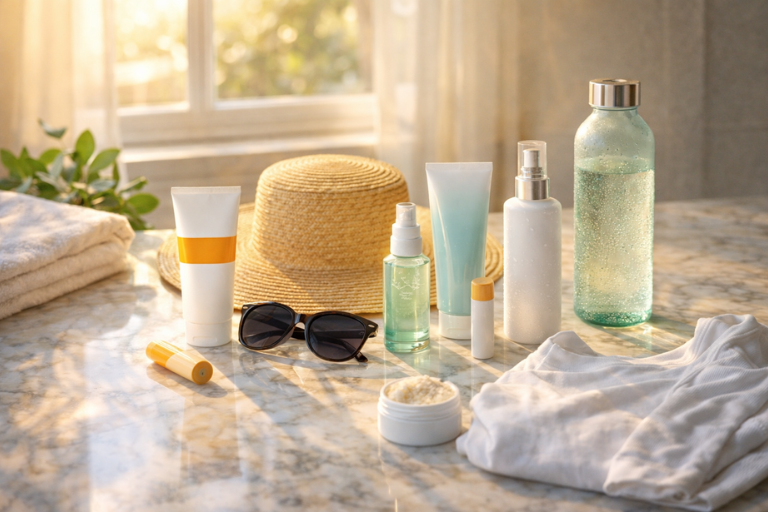
Even on days that don’t feel “sunny,” daily broad‑spectrum body sunscreen is non‑negotiable for preventing burns, photoaging, and skin cancer.
Apply 15–30 minutes before going outside. Use about 1 ounce (30 mL)—a full shot glass or golf ball‑sized amount—to cover all uncovered skin; larger bodies need more. Cover every exposed inch, not just high‑burn spots. Don’t forget ears, neck (front and back), hands, tops of feet, hairline, and scalp. Use sprays for hard‑to‑reach areas or ask for help.
Apply 15–30 minutes early and use a shot glass of sunscreen—every exposed inch counts.
Reapply at least every 2 hours, and immediately after swimming, heavy sweating, or towel‑drying. Water‑resistant formulas last 40–80 minutes in water.
Choose SPF 30+ broad‑spectrum, lightweight, non‑greasy textures; water‑resistant for workouts or swims. A 4 oz bottle should disappear in a day outdoors; daily use empties in about two months.
Frequently Asked Questions
How Do I Prevent Irritation From Workout Clothes and Friction?
Wear moisture‑wicking, breathable, non‑irritating fabrics. Choose loose or well‑fitting layers; avoid rough seams. Apply anti‑chafe balm or powder to hot spots. Change damp clothes fast, shower lukewarm, dry folds thoroughly. Use clean gear, monitor hot spots, rest irritated skin.
Can I Combine Self-Tanner With My Body Care Routine?
Yes—you can. Shower, shave, and exfoliate a day before. Lightly moisturize dry spots, then apply tanner with a mitt. Let it dry, wear loose clothes, moisturize daily, alternate acids/retinoids, avoid heavy oils pre-tan, and keep using SPF.
What’s the Best Routine for Tattoos During Healing and After?
Follow a strict cleanse-moisturize-protect routine. Wash with lukewarm water and gentle soap, pat dry, apply thin fragrance-free balm, don’t pick, avoid sun, soaking, friction, and heavy sweat. After healing, moisturize daily and wear SPF 30–50 to preserve vibrancy.
How Should I Store Products to Keep Them Effective Year-Round?
Store products in a cool, dark, dry cabinet (50–77°F). Avoid sunlight, heat, and bathroom humidity. Keep lids tight; prefer opaque, airless pumps. Refrigerate toners, sheet masks, and soothing gels; skip for oils. Don’t stash SPF or balms in hot cars.
Are Body Oils Useful, and When Should I Apply Them?
Yes—body oils help seal moisture, support your barrier, and smooth texture. Apply a thin layer right after showering on damp skin, over lotions or serums. Use daily; choose linoleic-rich oils; go lighter in humid weather, richer in winter.
Conclusion
You’ve got everything you need to build a body care routine that actually works. Keep showers lukewarm, cleanse gently, and lock in moisture right after you towel off. Exfoliate 1–3 times a week, target body acne and KP with smart actives, and rotate moisturizers with the seasons. Add antioxidants and retinol for tone and texture, and don’t skip broad-spectrum sunscreen—daily. Stay consistent, listen to your skin, and you’ll see smoother, healthier results all year.